

Every Power Must Serve Humanity and Human Dignity
Speech at the National Hellenic Society’s Heritage Weekend & Classic 2026, Washington, D.C.
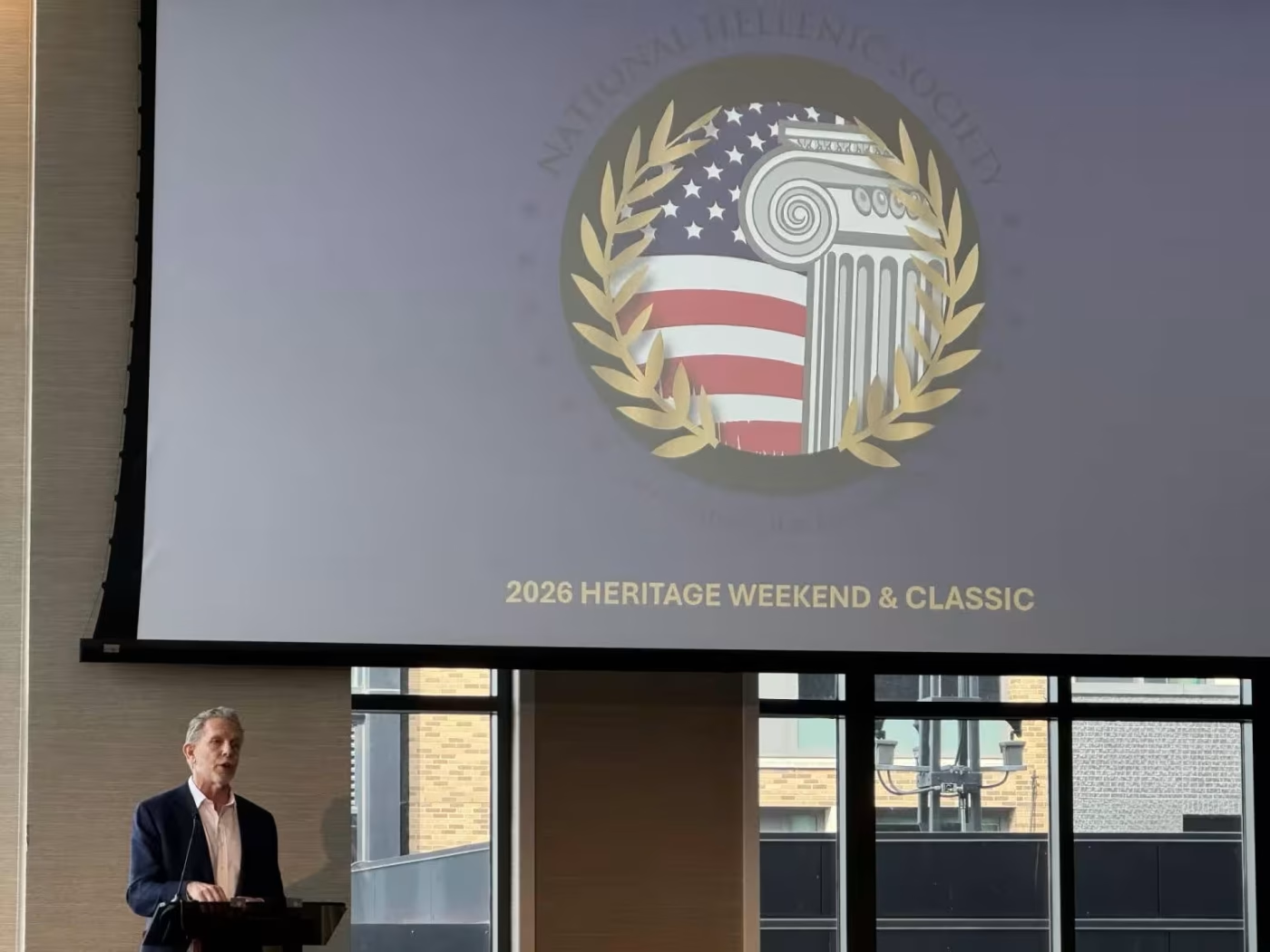
Ladies and Gentlemen,
For decades after the birth of Buddhism, the Buddha had no human form.
In the early centuries, the Buddha is depicted as an empty throne, a wheel, a tree, or simply, a footprint.
Suddenly, in the 1st century BC, in Gandhara, Afghanistan, the Buddha appears with a body and a human face. Not just any human face. The face of Apollo.
Buddhism had come into contact with Hellenism.
I cannot imagine a more appropriate forum than this a better city than this or a better audience than this to speak to the diaspora of the greatest challenge we will face as Greeks in the 21st century.
Surely, economic growth and private debt, low birth rates and the desertion of the Greek countryside constitute major challenges for our nation, but they concern us as Greeks and the future of our homeland exclusively.
Instead, I have come here to talk about a challenge we face as Greeks, that concerns the future of Humanity.
Because in this, our century, the very essence of Human nature will be challenged.
No longer shall we be concerned with how and to what extent machines simulate human nature.
But about how and to what extent human nature shall need to simulate machines in order to survive and thrive.
Biomedicine, genetics, neuroscience, together with artificial intelligence and a series of recent scientific developments, will force us to explore once more who we are, and what values govern our being.
In this context, the world will search for those values that can sustain our human nature as we comprehend it today. Inevitably, they will come to us.
Obviously, I don’t mean they will come to Greece or the NHS exclusively.
But they will once again seek to learn from the Greek way of thinking.
And the question we face is whether we will be prepared to respond to their quest.
You might ask: First, how do you know they will seek the answers they’re looking for in Greek values?
And second, why should this matter to us amid the many pressing everyday problems we already face?
History answers the first question.
From the Buddha of Gandhara to the Enlightenment, and from Shakespeare to Christopher Nolan,
Greek values are summoned, over and over again, to answer contemporary problems.
Take the Odyssey, now showing in theaters. Whether you like the film or not, there is no doubt that the work of Homer is being used by an American director to speak to America’s contemporary problems. In their own language.
This is not a new phenomenon.
Since the time of Pisistratus, when the Odessey was actually written down, Homer’s work never rested in the place and time where it was created.
It traveled. It was translated. It was interpreted. It changed form: it became poetry, theater, painting, music, cinema.
It remained alive because every era was able to recognize within it something of its own anguish, something of its own Humanity.
Today, however, I’m not referring to the interpretation of a single work.
I’m speaking about a much broader and more general exploration into the Greek way of life.
I participate in a group of Williams College alumni working on the future of our alma mater.
As part of the process, we asked to speak with the heads of the companies developing technologies that will soon sweep the world.
We asked them one question: “How should a university teach technology?” “Don’t bother,” they said. “What do you mean, ‘don’t bother’?” we asked. “Technology,” they answered, “is changing so rapidly, so drastically, that we can’t teach it to you in time for you to teach your students.
We will teach them technology. Can you shape them into decent Human beings?”
“What do you mean?” we asked again. “Can you teach them history, philosophy, and ethics?
Can you teach them music, theater and poetry? Can you teach them the Greeks?”
“Why is that useful to you?” was our last question, but their answer startled us.
“Because in our hands technology is frighteningly dangerous. In theirs, it can save the world.”
I insist. Sooner or later, the world will knock on our door.
Maybe not Greece as a nation, maybe it will not be Greeks at all, but certainly the world will knock the doors of those who know and have studied Greek civilization and the way it translates into our Greek way of life.
Because Greek cultural tradition has a unique characteristic shared only by the Chinese: more than three thousand years of continuous written expression.
Greek culture commands a vast reservoir of words, concepts, inquiries, and ways of understanding the world.
From antiquity and the Holy Scripture to our modern way of life, and from Athens to the ends of the world where Greeks study, research and teach.
This reservoir is not simply our heritage. It is a tool to shape the future of Humanity.
Not because it ever presented humans as perfect. Quite the opposite.
It presented us with our passions, our shortcomings, our contradictions, and our weaknesses.
But it placed us at the center of life as free and responsible beings.
In Homer, even a foe has a face and a family. Even the enemy feels pain.
In tragedy, every form of power is judged for its actions.
In philosophy, truth is not imposed. It is sought through dialogue.
And in democracy, a person is not a subject. A person is a citizen.
This is perhaps the most timely message that Greek civilization can offer to the evolution of Humanity today: that every power — political, social, cultural, economic, and/or technological — must serve Humanity, and the dignity of the Person.
The second question you might ask me is: “Why should this matter to me?” I will provide several reasons. Pick the one that seems relevant to you:
Because you care about the future of Hellenism and the future of Humanity. Because you care that Hellenism has a say in the future of Humanity. Because a world without our Hellenic culture will be problematic to both the world and to culture. Because you don’t want to see our way of life receding into the annals of history.
Or simply because it’s in our immediate best interest. Geostrategically as well as economically.
After all, Greece’s standing on the global scene has always been far greater than its geopolitical and economic weight, because of our culture.
When Greece joined the European Economic Community, which continued to support and strengthen Greece economically after the Marshall Plan, the President of France, Giscard d’Estaing, said, in supporting our candidacy, that Europe without Greece is like a person without a birth certificate.
He meant that Europe without the birthplace of Humanism shall never be complete. The same is true today of every form of globalization.
Not long ago, a beloved cousin of mine, Stefanos Geroulanos, a historian at New York University, published a book analyzing the distortions Homo Sapiens introduced in describing the history of the humans who came before us, such as the Neanderthals.
Distortions owed to one reason: when the history of the Neanderthals was written, the latter had no presence and no voice.
So the question we face is this: will humans today, and the Hellenic values that have shaped us, have a voice in the world we are building, or will they be lost in the noise of humans enchanted by technological innovation?
Artificial Intelligence is not born in a cultural vacuum. It learns from the material we give it.
From the languages that have the greatest presence online. From the images, narratives, and values of those who have the power to turn them into data.
And when a civilization is not present in this data, it risks becoming invisible. Not necessarily because it ceased to exist. But because machines learn to see the world without it.
Similarly, Artificial Intelligence can copy a work, can produce something that resembles art, can substitute for human creativity.
But our civilization was never shaped by the final work.
It was shaped by the lived experience that gave birth to the work. The memory.
The anguish. The need of one human being to communicate with another. Most of all, by the emotions that shaped the work.
After all, what would the Guernica of Picasso mean today, without the Guernica of the massacre?
Machines will feign emotion up to the point that logic allows. But they will never feel it.
So, without Humanistic values that restore Humans to the center of creativity, contemporary civilization will be nothing more than the interpretation of Humans who have ceased to exist.
These developments are enough to cause terror. But terror and fearfulness are not the way to shape the future. Fearfulness might keep you preserved a little longer, in the face of the tectonic changes underway. Until you fade away in the mists of time.
If you want to shape the world and its future, you have to fight for it.
You have to go on the offense with the courage and confidence that come from the value you bring to the table.
And that’s why I’m here: to tell you that the first priority we must set is to transform our civilization and our cultural policy from fearful, defensive, and conservative, into dynamic, assertive, and progressive.
Ready to change the world around it. Adaptable enough to become impactful.
Our choices and policies must to ensure our cultures participation in, and influence on, this current global dialogue.
Why? Because the very same technology that can make a civilization invisible can also make it visible to the entire world.
It can give a child in Africa, Asia, or Latin America access to the Greek language, to history, to philosophy, to our music and our theater. To the Greek way of life.
It can translate a contemporary Greek book into hundreds of languages. It can open our museums and archives to people who will never be able to travel to Greece.
It can help restore monuments, save ancient texts, connect fragments of our history that remained separated until today.
It can give new tools to our writers, our musicians, our directors, our archaeologists, to each person keeping a local tradition alive.
And it can do something even more important. It can allow Greek civilization to meet other civilizations again.
Not as a museum exhibit, but as a living creative force. Just as it happened in Gandhara many centuries ago.I’ll close with “how can we prepare for what is coming?”
First, we need to digitize our cultural wealth — extremely aggressively, with a plan and shared rules: the archives, the collections, the books, the music, the customs, foods and dialects of every place.
From Homer to the beautiful traditions around the Greek table.
Not to be locked away on different public-sector platforms. But to become a safe, high-quality, and accessible reservoir of knowledge, on which Artificial Intelligence systems can be trained: Both Greek and international.
Second, we need to protect the one without whom civilization does not exist: the creator.
With clear rules on consent, transparency, attribution, and fair compensation when a work is used to train or run a system.
Third, we need to give access to new tools to all people working in various cultural fora around Greece. Not only to major institutions of Athens.
But also to regional theaters, municipal museums, libraries, small festivals, young creators, and local communities.
To Greeks producing Greek culture outside Greece’s borders. With training, technical support and funding that reaches every community where our culture is produced or preserved.
Fourth, we need accountability. Every public program for culture and Artificial Intelligence should have specific goals, a budget, milestones, a named person responsible, and transparent results.
So that we know who decides, who is funded, who is accountable, and ultimately who are the beneficiaries of our policies.
But above all, we must make our mark on the global dialogue. Culturally, politically, socially, and economically.
With bold moves that will establish us as the voice of global Humanistic values.
I have a vision: to mobilize Greek universities and Greek cultural institutions, together with the best universities and cultural institutions around the world — from Japan to California — along with all the major players in new technologies, to establish a Global Research Center for the Ethics of New Technologies at the Academy of Plato.
A place where scientists, technologists, philosophers, theologians, historians, artists, lawyers, educators, and citizens will discuss the boundaries we must set for technology, and the best way to develop it.
A place, possibly under the auspices of the United Nations, that will produce rules, knowledge, and proposals for Greece and the world.
Obviously, without a pretense that we have all the answers.
But with the confidence that Greeks have, for centuries, known how to ask the right questions.
If you don’t think this possible, think again. I can tell you the interest already exists. But it is up to us to act on this interest now!
Ladies and gentlemen,
Before the Buddha took human form, he was an empty throne. Greeks gave him a human face. A beautiful human face.
Today, globalization and new technologies have once again left an empty throne. The question is whether we, the Greeks of today, can give it the Human form it so desperately needs. This is not a rhetorical question. Its answer may determine our role in shaping human history. And the survival of Humanity.
Thank you.